Start Entrepreneur Online
dedicated creating better information and guides for online entrepreneurs, enjoy the online business world!
Support this channel to make online
NEW ORLEANS — Weather forecasters warned residents along Louisiana’s coast to rush preparations Saturday in anticipation of an intensifying Hurricane Ida, which is expected to bring winds as high as 140 mph (225 kph) when it slams ashore on Sunday.
Authorities called a combination of voluntary and mandatory evacuations for cities and communities across the region. In New Orleans the mayor ordered a mandatory evacuation for areas outside the city’s levee system and a voluntary evacuation for residents inside the levee system. But since the storm quickly escalated in intensity, Mayor LaToya Cantrell said it was not possible to order a mandatory evacuation for the entire city, which would require using all lanes of some highways to leave the city.
[time-brightcove not-tgx=”true”]
Traffic was heavy on westbound routes out of town early Saturday and gas stations were busy.
The storm is expected to make landfall on the exact date Hurricane Katrina devastated a large swath of the Gulf Coast 16 years earlier. But whereas Katrina was a Category 3 when it made landfall southwest of New Orleans, Ida is expected to reach an extremely dangerous Category 4 hurricane, with top winds of 140 mph (225 kph) before making landfall likely west of New Orleans late Sunday.
“Today is it,” Jamie Rhome, acting deputy director of the U.S. National Hurricane Center in Miami, said Saturday. “If you’re in coastal Louisiana and Mississippi, you really, really have to get going because today is it in terms of protecting life and property.”
Ida intensified rapidly Friday from a tropical storm to a hurricane with top winds of 80 mph (128 kph) as it crossed western Cuba. It’s expected to pick up steam as it goes over the warm waters of the Gulf of Mexico.
On Saturday morning, Ida was centered 440 miles (710 kilometers) southeast of New Orleans. It was traveling northwest at 16 mph (26 kph), forecasters said. It’s maximum sustained winds had increased to 85 mph (140kph).
In New Orleans, city officials said residents need to be prepared for prolonged power outages, and asked elderly residents to consider evacuating. Collin Arnold, the city’s emergency management director, said the city could be under high winds for about ten hours. Earlier Friday, Cantrell called for a mandatory evacuation for residents outside the city’s levee protections — a relatively small sliver of the city’s population.
Ida would be the latest test of the New Orleans’ aging street drainage system. In a statement Friday, the city outlined steps it was taking to ensure that pumps were working and power sources to those pumps were ready. But, the amount of rain could be enough to overwhelm even a fully functional system.
“We want to be clear, that with the amount of rain now forecasted, approximately 10 inches over the course of the event, it is likely that we will experience flooding,” the city said in a late Friday statement.
Some ordinarily bustling businesses were closed Saturday. One popular breakfast spot was locked up tight with sandbags against the door to guard against flash floods.
With the storm’s forward speed slowing down and the intensity picking up, the storm surge may overtop some levees that protect parts of New Orleans on the west bank of the Mississippi River, said Heath Jones, emergency manager, of the Army Corps of Engineers’ New Orleans District. However he said they are designed to be overtopped and have protections in place to prevent more damage. There does not appear to be any danger of storm surge coming over the levees that protect the city’s east bank, which makes up most of the city, he said.
Across the region, residents were filling sandbags, getting gas for cars and generators and stocking up on food. Capt. Ross Eichorn, a fishing guide on the coast about 70 miles (112 kilometers) southwest of New Orleans, said he fears warm Gulf waters will “make a monster” out of Ida.
“With a direct hit, ain’t no telling what’s going to be left — if anything,” Eichorn said. He added: “Anybody that isn’t concerned has got something wrong with them.”
A hurricane warning was issued for most of the Louisiana coast from Intracoastal City to the mouth of the Pearl River. A tropical storm warning was extended to the Mississippi-Alabama line.
At the same time hospitals are preparing for the storm, they are still dealing with a fourth surge of the coronavirus. Officials decided against evacuating New Orleans hospitals. There’s little room for their patients elsewhere, with hospitals from Texas to Florida already packed with patients, said Dr. Jennifer Avengo, the city’s health director.
At the state’s largest hospital system, Ochsner Health System, officials ordered 10 days worth of fuel, food, drugs and other supplies and have backup fuel contracts for its generators. One positive was that the number of COVID-19 patients had dropped from 988 to 836 over the past week — a 15% decline.
President Joe Biden approved a federal emergency declaration for Louisiana ahead of the storm. White House press secretary Jen Psaki said FEMA plans to send nearly 150 medical personnel and almost 50 ambulances to the Gulf Coast to assist strained hospitals.
Ida made its first landfall Friday afternoon on Cuba’s southern Isle of Youth. The Cuban government issued a hurricane warning for its westernmost provinces, where forecasters said as much as 20 inches (50 centimeters) of rain could fall in places, possibly unleashing deadly flash floods and mudslides. Landfall in the U.S. is expected late Sunday in the Mississippi River delta region.
If that forecast holds true, Ida would hit 16 years to the day that Hurricane Katrina made landfall with 125 mph (201 kph) winds near the riverside community of Buras.
Katrina is blamed for an estimated 1,800 deaths from the central Louisiana coast to around the Mississippi-Alabama state line. A massive storm surge scoured the shores and wiped houses off the map. In New Orleans, failures of federal levees led to catastrophic flooding. Water covered 80% of the city and many homes were swamped to the rooftops. Some victims drowned in their attics. The Superdome and New Orleans Convention Center became scenes of sweltering misery as tens of thousands were stranded without power or running water.
Additionally, the hurricane center said a new tropical depression formed early Saturday. It was centered 820 miles (1,320 kilometers) east-southeast of the Leeward Islands. It was expected to remain over the open Atlantic Ocean and posed no hazards to land.
from RSSMix.com Mix ID 13001087 https://ift.tt/3mKFDZF
WASHINGTON — Acting swiftly on President Joe Biden’s promise to retaliate for the deadly suicide bombing at Kabul airport, the U.S. military said it killed a member of the Islamic State group’s Afghanistan affiliate with a drone strike in the group’s eastern stronghold.
–==as the U.S.-led evacuation from Kabul airport moved into its final days. Biden has set Tuesday as his deadline for completing the exit.
Biden authorized the drone strike and it was ordered by Defense Secretary Lloyd Austin, a defense official said, speaking on condition of anonymity to provide details not yet publicly announced. It was not immediately clear whether the targeted IS member was directly involved in Thursday’s airport attack.
[time-brightcove not-tgx=”true”]
U.S. Central Command said the targeted individual, whose name and nationality were not released, was an IS “planner” and that he was hit in Nangarhar province, which borders Pakistan in eastern Afghanistan and was an early IS stronghold.
A U.S. official said Saturday that the targeted individual appeared to survive an initial drone strike aimed at the vehicle in which he was riding. A second strike killed him, the official said, speaking on condition of anonymity to provide details not yet publicly released.
The airstrike was launched from beyond Afghanistan less than 48 hours after the devastating Kabul attack that killed 13 Americans and scores of Afghans with just days left in a final U.S. withdrawal after 20 years of war. U.S. Central Command said it believed its strike killed no civilians.
The speed with which the U.S. military retaliated reflected its close monitoring of IS and years of experience in targeting extremists in remote parts of the world. But it also shows the limits of U.S. power to eliminate extremist threats, which some believe will have more freedom of movement in Afghanistan now that the Taliban is in power.
Central Command said the targeted IS member was believed to be involved in planning attacks against the United States in Kabul. The strike killed one individual, spokesman Navy Capt. William Urban said.
It wasn’t clear if the targeted individual was involved directly in the Thursday suicide blast outside the gates of the Kabul airport, where crowds of Afghans were desperately trying to get in as part of the ongoing evacuation.
The airstrike came after Biden declared Thursday that perpetrators of the attack would not be able to hide. “We will hunt you down and make you pay,” he said. Pentagon leaders told reporters Friday that they were prepared for whatever retaliatory action the president ordered.
“We have options there right now,” said Maj. Gen. Hank Taylor of the Pentagon’s Joint Staff.
The president was warned Friday to expect another lethal attack in the closing days of a frantic U.S.-led evacuation. White House press secretary Jen Psaki said Biden’s national security team offered a grim outlook.
“They advised the president and vice president that another terror attack in Kabul is likely, but that they are taking maximum force protection measures at the Kabul airport,” Psaki said, echoing what the Pentagon has been saying since the bombing Thursday at Kabul airport.
Late Friday, the State Department again urged Americans to stay away from airport gates, including “the New Ministry of Interior gate.”
Few new details about the airport attack emerged a day later, but the Pentagon corrected its initial report that there had been suicide bombings at two locations. It said there was just one — at or near the Abbey Gate — followed by gunfire. The initial report of a second bombing at the nearby Baron Hotel proved to be false, said Maj. Gen. Hank Taylor of the Pentagon’s Joint Staff; he attributed the mistake to initial confusion.
Based on a preliminary assessment, U.S. officials believe the suicide vest used in the attack, which killed at least 169 Afghans in addition to the 13 Americans, carried about 25 pounds of explosives and was loaded with shrapnel, a U.S. official said Friday. A suicide bomb typically carries five to 10 pounds of explosives, said the official, who spoke on condition of anonymity to discuss preliminary assessments of the bombing.
Biden still faces the problem over the longer term of containing an array of potential extremist threats based in Afghanistan, which will be harder with fewer U.S. intelligence assets and no military presence in the nation.
Emily Harding, a former CIA analyst and deputy staff director for the Senate Intelligence Committee, said she doubted Biden’s assurances that the United States will be able to monitor and strike terror threats from beyond Afghanistan’s borders. The Pentagon also insists this so-called “over the horizon” capability, which includes surveillance and strike aircraft based in the Persian Gulf area, will be effective.
In an Oval Office appearance Friday, Biden again expressed his condolences to victims of the attack. The return home of U.S. military members’ remains in coming days will provide painful and poignant reminders not just of the devastation at the Kabul airport but also of the costly way the war is ending. More than 2,400 U.S. service members died in the war and tens of thousands were injured over the past two decades.
The Marine Corps said 11 of the 13 Americans killed were Marines. One was a Navy sailor and one an Army soldier. Their names have not been released pending notification of their families, a sometimes-lengthy process that Pentagon spokesman John Kirby said involves “difficult conversations.”
Still, sorrowful details of those killed were starting to emerge. One Marine from Wyoming was on his first tour in Afghanistan and his wife is expecting a baby in three weeks; another was a 20-year-old man from Missouri whose father was devastated by the loss. A third, a 20-year-old from Texas, had joined the armed services out of high school.
Biden ordered U.S. flags to half-staff across the country in honor of the 13.
They were the first U.S. service members killed in Afghanistan since February 2020, the month the Trump administration struck an agreement with the Taliban that called for the militant group to halt attacks on Americans in exchange for a U.S. agreement to remove all American troops and contractors by May 2021. Biden announced in April that he would have all forces out by September.
Psaki said the next few days of the mission to evacuate Americans and others, including vulnerable Afghans fleeing Taliban rule, “will be the most dangerous period to date.”
The White House said that as of Saturday morning, about 6,800 people were airlifted from Kabul in the past 24 hours on U.S. and coalition aircraft. Nearly 112,000 people have been airlifted over the last two weeks, according to the White House. The administration has said it intends to push on and complete the airlift despite the terrorist threats.
Kirby told reporters the U.S. military is monitoring credible, specific Islamic State threats “in real time.”
“We certainly are prepared and would expect future attempts,” Kirby said. He declined to describe details of any additional security measures being taken, including those implemented by the Taliban, around the airport gates and perimeter. He said there were fewer people in and around the gates Friday.
___
Associated Press writers Aamer Madhani, Darlene Superville and Nomaan Merchant contributed to this report.
from RSSMix.com Mix ID 13001087 https://ift.tt/38kONDL
The New York City Police Department (NYPD) is struggling to vaccinate its employees. According to the department, an estimated 47% of its members are fully vaccinated under NYPD-administered programs against COVID-19 as of Aug. 24.
Even accounting for a percentage of the NYPD’s force who may have been vaccinated outside work and not provided details thereof—the NYPD is not mandating that its employees self-report their status—that figure likely represents a sizable decrease from the wider vaccination rates across New York City: 76% of all adult city residents have gotten at least one shot as of Aug. 26 and 68% are fully vaccinated. And amid the Delta variant impacting non-vaccinated New Yorkers, the COVID-19 positivity rate in NYC over the last seven days is around 3%.
[time-brightcove not-tgx=”true”]
On July 26, NYC Mayor Bill de Blasio said that all city workers would be required to get vaccinated or get tested weekly from Sept. 13 onwards. And on Aug. 23, the Pfizer-BioNTech vaccine became the first COVID-19 vaccine to be approved by the U.S. Food and Drug Administration (FDA).
But one Brooklyn-based traffic enforcement agent tells TIME they have no immediate intentions of getting the vaccine: “I just don’t feel like I need it yet. I spend most of my time outside and I wear a mask,” the traffic officer says. “For me, it’s about having the choice to take it—and I just don’t want to take it yet.”
(A spokesperson for the New York City Patrol Benevolent Association (PBA), the largest police union in New York City, told TIME on Aug. 25 that they would take “legal action” if there is a vaccine mandate for its workers.)
A 911 operator says they too don’t want to get vaccinated, and they don’t like the idea of being required to do so either. “[I think] people don’t want to feel obliged or forced to get the vaccine,” the operator says. “It’s not like I’m constantly in someone else’s personal space. I social distance and wear a mask. Why do I need to get vaccinated right now?”
TIME has granted the two sources anonymity to allow them to speak openly on the subject of vaccinations due to their concerns of potential reprisals at work.
Both NYPD members say they feel like most of their colleagues take enough precautions; they are aware of working alongside both people who are vaccinated and who aren’t.
“We continue to make vaccinations available at multiple times and at multiple locations to ensure that as many of our employees as possible get the vaccination,” the NYPD said in a statement sent to TIME on Aug. 24.
This issue isn’t unique to New York. Many cities across the country have seen low vaccination numbers amongst their police departments. The Los Angeles Police Department (LAPD) reported on Aug. 16 that they also have a vaccination rate of around 47%, for example, while the Los Angeles County Sheriff’s Department reported that less than 30% of their deputies have been vaccinated.
A 2020 study from the National Law Enforcement Officers Memorial Fund found that, of all the officer deaths recorded across the U.S. in 2020, nearly half were the result of COVID-19. On Aug. 23, Houston Police Department Chief Art Acevedo tweeted that he had signed, “10 more condolence letters for active-duty officers who have been taken from their families, friends, and colleagues by#COVID19. We are lifting them all in prayer,” though it was not clear during what timeframe the officers had died.
And last week was a particularly grim week for the NYPD as three members of the department died from COVID-19. (60 NYPD employees have died from COVID-19 since the start of the pandemic.)
“When you look at who is getting sick right now, every story I hear anecdotally, it’s somebody that is not vaccinated,” NYPD Commissioner Dermot Shea said in a July 27 interview with local news channel NY1 calling for NYPD officers to take COVID-19 vaccines. “God forbid, you put yourself or your loved ones or anyone else at risk. It’s the right thing to do.”
The traffic cop says the deaths are heartbreaking, but they still aren’t ready to get vaccinated.
“I just want to wait a little longer. I follow all the other health [protocols] but before I get a shot I want to know it’s the right thing for my body,” they say. “Getting the vaccine is a decision I should make. Not my job.”
On Aug. 11, California became the first state to require all teachers and school staff to get vaccinated or get weekly testing. In Chicago, Mayor Lori Lightfoot confirmed a vaccine mandate on Aug. 25 for all city workers, an announcement which the head of the city’s Fraternal Order of Police later likened to the Nazi regime.
Unions have pushed back forcefully against these steps. In addition to the PBA’s apparent plans for litigation as disclosed to TIME, leaders representing over 300,000 city workers are planning to file a lawsuit against de Blasio for his vaccine mandate, specifically for public school staff.
Both the traffic cop and the 911 operator say that, if it comes down to them losing their job, then they would get their shots.
“If it’s between my job and the vaccine then I would get it. I would try to fight it but, eventually, I would get it,” the 911 operator says.
from RSSMix.com Mix ID 13001087 https://ift.tt/3znuLod
Long before a man with a bloody hook tormented the alleys of Cabrini-Green in the 1992 filmCandyman, the Chicago housing projects were understood by many to be a place of horror. For decades, local and national media told stories of murders, rapes, gangs, drugs and poverty run rampant, making it one of the most feared places in America.
But many of the residents who actually lived there felt differently: to them, Cabrini-Green wasn’t just a cesspool of immorality but also a tight-knit, family-oriented community that supported each other in the face of neglect, governmental corruption and police violence. And when filmmaker Nia DaCosta was given a chance to create a sequel toCandyman, she strove to show a different side of the maligned projects; to preserve the scariness of the original film while separating the monster from the community itself. “The original film definitely fed into a fear of the Black community, and the Black man in particular,” DaCosta tells TIME. “I didn’t want to do this approach of, ‘Oh, god, this terrible place where terrible things are happening, because these brutes are living here.’ This is a community that was chronically underserved for a very long time.”
[time-brightcove not-tgx=”true”]
In anticipation of the film’s release on August 27, TIME talked to filmmakers, historians and community members about the history of Cabrini-Green andCandyman’s role in its lore.
Decades of notoriety
When the Cabrini-Green housing projects started being built in the 1940s, the area’s reputation for violence was long established. In the 19th century, the neighborhood on the north fork of the Chicago River sat next to billowing, stinking gas refineries and factories, and became the landing place for waves of European immigrants searching for cheap housing in the city. The neighborhood soon became known as “Little Hell,” with frequent reports of mafia activity. “There was a mythical quality and almost aCandyman-like aspect of the ways the violence and gangs were described in that time,” Ben Austen, a Chicago journalist who wrote the bookHigh Risers:Cabrini-Green and the Fate of American Public Housing, says.
In 1937, the Chicago Housing Authority was founded to reform these sorts of slums while also combating asevere housing crisis precipitated by the Great Depression. They would soon embark on an ambitious public housing development project that mostly consisted of extremely segregated high rises, pushing Black families—many recent migrants from the South—into a “Black belt” on the city’s South Side. Further “urban renewal” projects and redlining displaced many other city dwellers and forced them into public housing; a 1955 study found that such projects served the interests of wealthy businessmen and institutions to keep public housing out of their wards.
Cabrini-Green, however, was supposed to be different from the others: an integrated, utopian community with affordable rent prices in the heart of the city, not far from Chicago’s Magnificent Mile. In 1942, Mayor Edward J. Kelly proclaimed that the apartments “symbolize the Chicago that is to be,” adding, “We cannot continue as a nation, half slum and half palace.”
But before long, the 3,600 public housing units of Cabrini-Green would soon become almost entirely Black and poor. Funding for upkeep and social services vanished, leaving buildings rotting and full of broken appliances and elevators. Shoddy construction even meant some apartments connected through their bathroom mirrors (a detail that would show up to grisly effect in the original Candyman). With little oversight, city-wide gangs like Vice Lords and Cobras moved in and warred with each other. In 1982,a study from the U.S. Department of Housing and Urban Developmentfound that the Chicago Housing Authority was one of the worst-managed public housing agencies in the nation.
It was this Cabrini-Green, in 1979, that the six-year-old Teddy Williams moved into with his mother and siblings. Williams says that the project’s reputation initially made his family scared to move there. He recalls: “The feedback that my grandmother got about Cabrini-Green made her leery about her daughter and grandchildren moving there. We connected with the same fears and were like, ‘Oh my god. Will it be bad?’”
Those fears were assuaged when the residents there quickly welcomed them into the fold. “It was like a little village: everybody knew everybody,” he says. “There was gang activity, but also a lot of structure amongst others that weren’t involved: after school programs where they’d have games, trampolines, screen painting, quilt sewing. We put on dance routines and dressed up like the zombies in theThrillervideo.”
Among the children in Cabrini-Green, there was certainly mythology about menaces, including a crazy man who lived on the otherwise-deserted 14th floor where the elevator would sometimes accidentally drop people off. (“If we had to get off on that floor, we would run really quick before he came out,” Williams says.) But a more frequent threat was the police, who were essentially engaged in warfare with the gangs in Cabrini-Green after two cops were shot dead by a sniper in 1970. “The police were kind of aggressive: I do remember some harsh moments,” he says. “When it came to police presence and gang members, it wasn’t a, ‘Go over, talk to you, and do an intervention’ kind of thing. It was, “We go over there, strong arm you and make you act right.’”
Cabrini-Green wasn’t the poorest, or the most crime-ridden, neighborhood. But its proximity to wealthier sections of the city made it a target for not only the police, but the local and national news. (Its status as the setting of the filmCooley Highand the TV showGood Timesalso increased general interest.) Newspapers and television crews would swarm in, hoping to capture stories of gore and poverty porn—and Cabrini-Green developed a reputation as one of America’s worst projects. OnSaturday Night Live, Danitra Vance, the first Black female cast regular, played a 17-year-old mother of two named Cabrini-Green Jackson. (Vance later quit the show, frustrated after repeatedly being assigned stereotypical roles.) In 1981, Chicago MayorJane Byrneactually moved into Cabrini-Green to signal her commitment to the area—but she moved out within weeks, with the crime rate unaffected, and was voted out of office two years later.
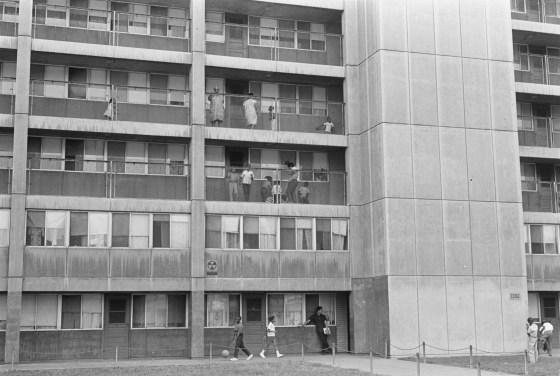
Pix/Michael Ochs Archives/Getty Images)Cabrini-Green in 1966.
The original Candyman and the razing of Cabrini-Green
Cabrini-Green essentially symbolized the plight of the American inner city—and in 1990, the English filmmaker Bernard Rose decided to capitalize on that reputation by transposing a short story by Clive Barker about a monster in the Liverpool slums to Cabrini-Green. His film followed Helen Lyle, a white woman, who ventured into the ghetto to research an urban legend about a hook-handed spirit who kills anyone who says his name five times into a mirror. Rose spoke to residents and actually filmed in Cabrini-Green, and ultimately created an atmosphere in which the streets were lined with garbage, feces was smeared on restroom mirrors, and vicious attackers popped out of the shadows and the walls.
Residents of Cabrini-Green and other low-income areas of the city viewed the film with both reverence and frustration. Some loved it, including J. Nicole Brooks, who would go onto act in the newCandymanand also write a play about Jane Byrne’s foray into Cabrini-Green,Her Honor, Jane Byrne. “It’s like asking a Chicagoan about Michael Jordan,” she says. “It was beautifully shot, thoughtfully done and terrifying.”
Brooks also says the mythology at the center of the film was not dissimilar to stories she heard growing up living right outside the Robert Taylor Homes, a housing project on the south side. “The folklore could actually save your life,” she says. “For example, ‘Do not go under the viaduct west of Comiskey Park unless there’s a White Sox Game.’ You grew up thinking the boogie man was all over Chicago—and for the most part, it was true.”
Others were wary about the way that the film fed into prevailing stereotypes about public housing. “Projects were so misunderstood and vilified,” the Chicago-based author and scholar Ytasha Womack says. “Their vilification was almost a reflection of the failures of social services to help support people when they were put in those places.”
Teddy Williams saw the film while living in Cabrini-Green, and says that conversations he had about the film at the time there were mostly positive. “I think the community was mostly okay with the movie, because it put us on the map again,” he says. “The only thing we would talk about is that Candyman could never live over here and do what he was doing, because he would get f-cked up.”
Candymanopened on Oct 16, 1992. Three days prior, the 7-year-old Dantrell Davis was shot to death by a local gang member in Cabrini-Green while walking to school. The incident made national headlines and shook the community to its core, with local gangs entering a truce. The historian Ben Austen says that the combination of those two concurrent events only exacerbated anxious views from public officials about the inner city that were circulating at the time—and could have played an implicit role in the demolishing of Cabrini-Green. “This is the same time as the crack epidemic, the image of gangs wilding in Central Park, John DiIulio talking about superpredators,” he says. “This mythology takes real world effect and shapes policy—and we get isolation, demolition and mass incarceration.”
In 1999, Chicago Mayer Richard M. Daley and the Chicago Housing Authority kicked off a $1.6 billion Plan For Transformation, in which they sought to rip down public housing across the city, build or rehabilitate25,000 new public units, and turn the land over to eager developers. Daley said that that mixed-income would take the place of slums and said of the relocated, “I want to rebuild their souls.”
But historians and community members say that the transition was mishandled. “It was a human rights disaster,” Austen says. Residents were forced out of the homes and support systems that had kept them upright for decades; the section eight vouchers they received often pushed them to poorer, more segregated areas of the city. And despite all the headlines about Cabrini-Green being an uninhabitable place, a group of residentsactually unsuccessfully sued to stay there.
One of the residents who hoped to stay was Williams. When his tower came down in 2011, he didn’t receive a voucher, since he was living with his mother at the time. Unsure of where to go, Williams says he was homeless for about three years, staying on the couches of friends and family or riding the trains. He got a job as a barber and slept in the salon basement until he was able to afford his own place; he now lives in Oak Park, Illinois. “It was kind of a rough transition,” he says.
The area is now gentrified, covered with gleaming offices and condos and fancy restaurants. While Mayor Daley said that the new developments would include plenty of affordable housing for residents to return to the neighborhood, the 15,000 promised family units in the city overall pale in comparison to the city’s actual need.When the CHA opened its public-housing waiting list in 2010, more than 215,000 families applied.
“It was just like, ‘We’re going to bring upper class people here—we don’t need riffraff around here, causing trouble,’’” Williams says.
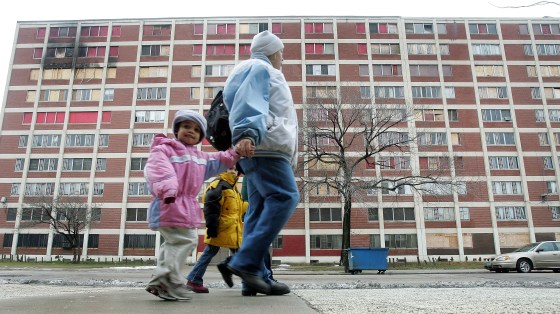
Tim Boyle/Getty ImagesResidents walk past one of the few remaining Chicago Housing Authority Cabrini-Green public housing buildings in 2005.
Reclaiming history through film
The filmmaker Nia DaCosta isn’t from Chicago; she grew up in Harlem, and says that seeingCandymanas a child was “the first time that what was happening in a horror film could absolutely happen to me. Candyman was actually just over there, across the street.”
But even though there were similarities between Harlem and Cabrini-Green, DaCosta made it an utmost priority of herCandymansequel to learn about the neighborhood’s specific history through historians and residents. DaCosta says that she and her team talked to dozens of locals about their experiences, who emphasized similar aspects as Teddy Williams did—of pride and community. “We wanted to take that pride and expand it as opposed to chip away at it,” DaCosta says. “We wanted to show this amazing sense of community and the way people took care of each other and looked after each other. And even when we introduceCandyman, it’s not the monster we think it is.”
Candymanwasshot on-location, including in some Cabrini-Green row-houses that are still standing. (They also used CGI to recreate the torn-down towers.) “There are certainly places you can use to fake Chicago, and shoot something that would be more inexpensive,” Win Rosenfield, a co-writer and co-producer on the film, says. “But that was never a question. We always felt it was important that this film, like its predecessor, live in Cabrini-Green and relate to the people of Chicago in an intimate way.”
So, the film’s cast includes local actors, like J. Nicole Brooks; presents explicit conversations about gentrification, erasure and neglect; and also mentions the names embedded in Cabrini-Green’s history, including Dantrell Davis and Girl X, who wasraped and torturedin Cabrini-Green in 1997. Their names are invoked by the character William Burke, who laments how their stories have been forgotten before referring to theCandymancharacter Helen Lyle: “A white woman dies and the story lives on forever.”
“When people think about Cabrini-Green, they think about this fake thing as opposed to the real children who were harmed there,” DaCosta says. “Fiction tends to spread farther than nonfiction—and as a filmmaker, it’s important to be cognizant of not perpetuating the same old stories.”
One way that DaCosta tried to tell a real story of erasure embedded in her genre piece was by shooting at theNorthside Stranger’s Home Missionary Baptist Churchon the corner of Clybourn Avenue and Larrabee Street. It once was a flourishing community center that displayed a vibrant 1972 mural called “All of Mankind” by William Walker, a Chicagoan known as the father of the urban art movement.
But once the neighborhood started to change, the church lost its constituency and was shuttered. In 2015, the lot went up for sale for potential use as a single-use family home, and themural was whitewashed over, to the dismay of preservationists. In 2018 the lot sold for $750,000 to a private bidder. But before it was converted, the new owners allowed DaCosta to shoot inside the church forCandyman’s pivotal scene.
“It was completely rundown and toxic fumes and mold and all this terrible stuff,” DaCosta says. “Part of the reason why we wanted to shoot there was because we’d seen these amazing pictures of the beautiful mural, and people on the right outside in their Sunday best. It really was a symbol of what had been erased. “
DaCosta hopes that her newCandymanwill both provide big scares in theaters while also forcing audience goers to reckon with the impacts of displacement and gentrification. Meanwhile, in real life, some of the old residents of Cabrini-Green have been able to move back into the newly refurbished neighborhood—but say they face discrimination and complaints from thenew, wealthier residents. Many more are still shut out, including Williams, who is holding out hope that he might be able to someday return. “Even though it had rough patches, we had love for our community,” he says. “Even if they didn’t upgrade anything, I wouldn’t mind going back to my neighborhood.”
from RSSMix.com Mix ID 13001087 https://ift.tt/3ks113i
Sometimes a movie arrives at just the right time, as if it were reading society’s collective mind. Candyman, directed by Nia DaCosta, and written by DaCosta, Jordan Peele and Win Rosenfeld, is one of those movies, a story rippling with ideas that many thinking people are already grappling with—or at least have finally become aware of.
This isn’t a remake of the 1992 film, directed by Bernard Rose and starring Virginia Madsen; instead, its creators have called it “a spiritual sequel,” a description that fits the bill. If the earlier movie featured a white woman “trying to understand” certain fears and coping mechanisms in a specific Black community—Chicago’s Cabrini-Green housing projects, whose demolition began in 1995—it was still almost all about her. The figure at the heart of this new Candyman, which uses the earlier film as a foundation, is an up-and-coming Chicago painter, Anthony McCoy (Yahya Abdul-Mateen II), who’s struggling to find his voice as an artist and yearning for recognition. His sudden obsession with the urban legend Candyman jolts his canvases to life—though it may not be the kind of life he wants.
[time-brightcove not-tgx=”true”]
If you’ve never seen the original film, you may have no idea who Candyman is. In that case, the only directive is to never say his name five times while looking in the mirror, or he’ll appear behind you, a murderous-seeming Black man in a long coat, with a hook where his right hand should be. Though this figure is fearsome—invented at least partly, so the lore goes, to keep kids on their best behavior—his story, as Rose’s movie first outlined it, is tragic: He’s the ghost of a man who was murdered by white people in the 1890s because he dared to fall in love with a white woman. The new Candyman expands on that premise: there are actually many Candymen who were similarly murdered, and who return in this particular form to wreak vengeance. As a local laundromat proprietor William Burke (Colman Domingo), who had his own run-in with Candyman as a child, explains to Anthony, “Candyman is how we deal with the fact that these things happened. That they’re still happening.”
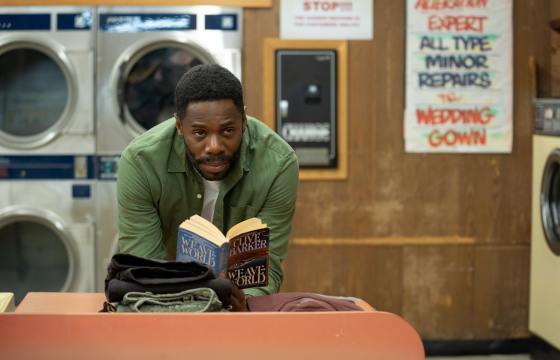
Universal PicturesColman Domingo in Candyman
Candyman spins out a lot of ideas at once: Anthony lives with his girlfriend, Brianna (Teyonah Parris), who’s a massively successful art curator. Their home is a jaw-dropping luxury loft that she pays for, and Abdul-Mateen conveys, subtly, how this rankles Anthony’s masculine pride. He wants to make his own way, and he yearns for success—things any artist might want, but a longing that’s likely even more pronounced among Black artists and other people of color.
Anthony’s fame escalates after one of his paintings plays a role in the death of a gallery owner; he knows he’s becoming famous for the wrong reasons, but he’ll take it anyway. And though he’s trim and handsome at the beginning of the story—he has plenty of time to work out—Anthony’s frame becomes more lumbering and twisted as his Candyman obsession intensifies. There’s a fair amount of body horror here, beginning with a bee-stung hand that continues to fester and flake. And if the plot is perhaps slightly overcomplicated, it’s for the most part thoughtfully worked out. It also makes room for actor Tony Todd, reprising the role he played in the earlier film, a respectful nod to the way movies take root in our consciousness.
Periodically throughout the movie, the Candyman legend is unfurled for us in a series of beautifully executed sequences of shadow puppetry. These mini plays-within-the-play, created by Chicago collective Manual Cinema and evoking the bracing silhouette work of Kara Walker, as well as the delicate innovations of animator Lotte Reiniger, are both discreet and direct in the way they depict the atrocities suffered by the men who will ultimately take the form of Candyman. Simultaneously captivating and mournful, they’re so effective they could constitute a mini-movie by themselves. Candyman is a work held together by thoughtful choices, and it has a lot to say. Genre conventions are themselves like urban legends, a framework that each new generation adds to and builds upon. Candyman is just one reason we continue to believe in them.
from RSSMix.com Mix ID 13001087 https://ift.tt/3kLR2WL
We are in a planetary emergency. Horrific heat waves and fires blaze across North America, Turkey and Russia. Extreme floods wreak destruction and cause death from Europe to Africa to Asia. Ocean temperatures and the amount of carbon in our atmosphere have reached unprecedented highs. July was the hottest month in recorded history. Our planet, as the United Nations recently warned, is flashing a “code red for humanity.”
There is no single solution to a crisis this large. Nations must fulfill the commitments they made under the Paris Agreement. Industries need to decarbonize, and businesses—especially the Fortune 1000—need to achieve net zero emissions. We need to empower a new generation of ecopreneurs—entrepreneurs focused on protecting our planet—to unleash innovative climate solutions. In our own lives, we need to adapt our lifestyles and consumption patterns.
[time-brightcove not-tgx=”true”]
None of these climate solutions are mutually exclusive. We need them all. If we are to save our planet—and ourselves—from irreversible climate change, we need to recruit everyone, everywhere in this mission.
This includes embracing a powerful climate solution that can be delivered by anyone, anywhere: trees.
Trees are our planet’s natural air purifiers—the single most effective “device” we have to pull carbon out of the atmosphere. In the U.S., for example, forests capture and store almost 15 percent of our carbon dioxide emissions every year—equivalent to the annual emissions from 163 million cars.
Tragically, we are losing trees at the very moment we need them most. Every six seconds, our planet loses a football pitch worth of tropical rainforest to deforestation. Forests in colder regions are losing millions of acres to drought, pests and wildfire worsened by climate change, and our rapidly growing cities are often losing the natural cooling of trees.
That’s why, last year, we helped launch a new global partnership with a bold new climate action goal—conserving, restoring and growing 1 trillion trees by 2030. Why a trillion? Because cutting-edge scientific analysis, led by the Crowther Lab, has identified enough ecologically suitable land around the world to help achieve this goal with reforestation. By some estimates, a trillion trees could sequester some 200 gigatons of carbon over their lifetimes—equal to the annual emissions from more than 43 billion cars.
When we announced our trillion-tree goal last year, some skeptics dismissed our work as misguided or unrealistic. But the past year has proven that progress is possible. Great Britain, Canada, the U.S., the E.U., China, India, Pakistan and Colombia have committed to plant billions of trees. Partnerships with indigenous communities aim to permanently conserve the planet-protecting forests and biodiversity of the Amazon Basin and the Sahel. Conservation efforts that have removed the world’s second largest rainforest—the Salonga National Park in the Democratic Republic of Congo—from the endangered list show what’s possible.
In its inaugural year, the U.S. chapter of 1t.org has secured pledges from more than 70 U.S. cities and states, companies and NGOs to conserve, restore and grow over 50 billion trees in the U.S. and abroad by 2030, and invest billions of dollars in workforce development, carbon finance and technology.
Now, as the world comes together next month for Global Citizen Live to rally the international community to address climate change and defeat poverty, and prepares for the pivotal United Nations climate change conference in November, we have the opportunity to spark a truly global effort.
This is a movement that everyone can join.
Every national, state, provincial or local government can make a commitment, like the State of Wisconsin, which will conserve and plant a total of 89 million trees, and the City of Dallas, which will conserve and plant more than 18 million trees.
Every business, large and small, can take action, like Mastercard, Salesforce and Aspiration, which have each committed to planting or protecting 100 million trees.
Every group that cares about our planet can set a goal, following the lead of Eden Reforestation and Sustainable Harvest International, which will plant billions of trees in developing nations, and diverse non-profits reforesting landscapes across America, from abandoned mine lands in West Virginia to burn scars in California.
Every community group can do something, like Girl Scout Troop 4 in Orange, New Jersey that planted 50 dogwood trees as part of the new Girl Scouts Tree Promise to plant five million trees.
Planting one trillion trees won’t be easy. It will depend on all of us taking action in our countries, our companies and our communities. And at a time when it’s easy to get overwhelmed by the relentless news of our changing climate, it’s something we have the power to do—right now. As the legendary conservationist Dr. Jane Goodall has said, “Now is the time for everyone on the planet to do their part.”
from RSSMix.com Mix ID 13001087 https://ift.tt/3gDfJTS